About SALT SPRAY CHAMBER
COMPLIANCE:
The basic system meets the requirements of ASTM B-117/ IS-1060 and
other similar standards.
APPLICATION:
Corrosion and weathering are the two major contributors, in degrading
the metal substrate. Certain conditions like humidity, and Salt spray
can be achieved or simulated in these chambers.
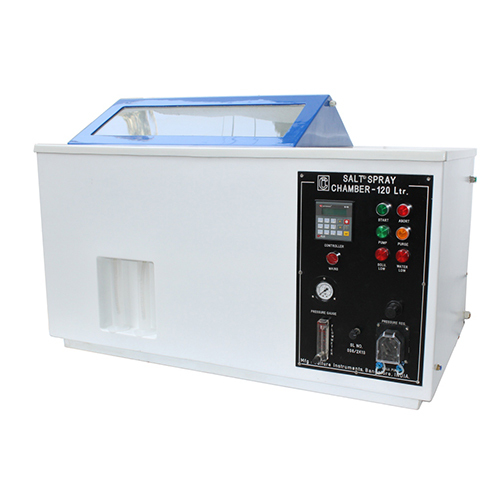
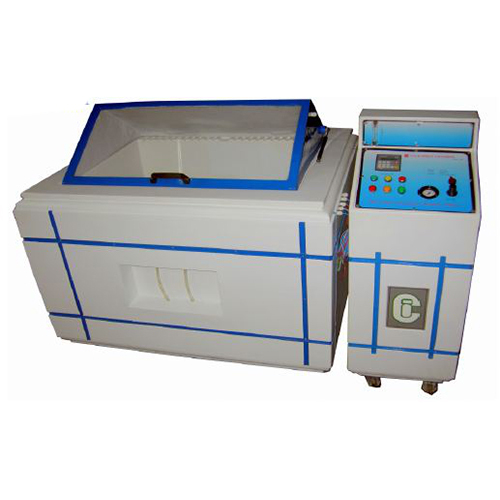
Advanced Corrosion SimulationDesigned to replicate highly corrosive environments, the Salt Spray Chamber enables rigorous evaluation of materials and coatings resistance to corrosion. Its FRP enclosure, corrosion-resistant glass nozzle, and programmable digital controls facilitate consistent and repeatable testing, supporting industrial quality assurance needs and research development.
User-Centric Digital ControlsEquipped with a digital PID controller and touch screen or push button interface, the chamber allows precise regulation of temperature and testing parameters. Users can effortlessly set test durations from a few hours up to 999 hours, ensuring flexible adaptation to various industrial testing requirements.
Compliant & Safe OperationMeeting international standards such as ASTM B117, JIS Z2371, and ISO 9227, and protected by features like a low water level alarm and door interlock switch, the chamber prioritizes both user safety and adherence to quality protocols. NABL-certified calibration ensures reliable test results for clients across industries.
FAQs of SALT SPRAY CHAMBER:
Q: How is the Salt Spray Chamber operated and controlled during the test process?
A: The chamber utilizes a digital PID controller and offers either touch screen or push button interfaces, allowing users to program all test parametersincluding duration, temperature, and test speed. Operation is largely automated, with an automatic timer and over-temperature protection, ensuring consistent test results with minimal manual intervention.
Q: What types of materials and specimens can be tested in this Salt Spray Chamber?
A: This chamber can accommodate a wide range of specimenstypically up to 150x80 mm, with the number of specimens ranging from 5 to 50 depending on the chamber size. Customizable racks make it suitable for metals, coated samples, and other industrial materials requiring corrosion resistance evaluation.
Q: When should a Salt Spray Chamber be used in your manufacturing or QA process?
A: Use the Salt Spray Chamber during product development, quality control, or routine material evaluation when you need to assess the corrosion resistance of parts, coatings, or assemblies. It is essential for components expected to endure aggressive environmental exposure.
Q: Where can this Salt Spray Chamber be installed, and what are its typical power requirements?
A: The Salt Spray Chamber is designed for floor-standing installation in laboratories or industrial testing environments. It operates on a standard 220V AC, 50Hz power supply, making it compatible with most industrial electrical setups in India and abroad.
Q: What is the procedure for loading specimens and running a test in the Salt Spray Chamber?
A: Begin by preparing specimens according to corrosion test standards, then load them onto the provided racks inside the chamber. Secure the transparent acrylic cover, set the desired test parameters on the digital controller, and initiate the test cycle. The device automatically manages fog generation, timing, and safety systems throughout the process.
Q: How does the chamber maintain compliance and accuracy throughout testing?
A: The chamber is calibrated using NABL-certified standards and features continuous digital monitoring of temperature (measuring range 040C, accuracy 0.5C, resolution 0.1C), humidity, and other environmental variables in accordance with ASTM B117, JIS Z2371, and ISO 9227 protocols.
Q: What are the key benefits of using this Salt Spray Chamber for corrosion testing?
A: Benefits include high durability due to its FRP and SS316 construction, precise environmental control; easy compliance with international test standards; enhanced safety features; and adaptability for a variety of specimen types and testing durations, ultimately delivering reliable and actionable corrosion performance data.




 Send Inquiry
 Send Inquiry

