About Liquid Limit Apparatus
Fabricated as per IS: 2720 (Part V),
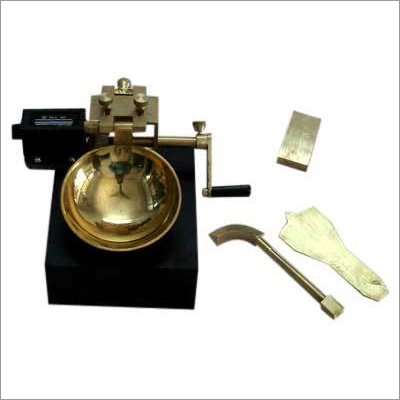
Liquid Limit Apparatus is especially designed to determine the liquid limit of soil. It is also used to determine the plasticity index of soil. Liquid Limit is a specific water content at which a definite part of soil is cut by a groove of standard dimension that will flow together up to a distance of 1.25cm under air impact of around 25 blows in a that standard Liquid Limit Apparatus.
The specifications of a Liquid Limit Apparatus Are : - A brass cup held on adjustable brackets.
- Grooving tools along with a 10mm gauging block to adjust the height of the blow.
- A counter which is fitted to register the number of blows.
Liquid Limit Apparatus is a very important device and one which is available widely in the market. We are providers of excellent quality Liquid Limit Apparatus as each of our units have been made with best quality materials.
Precision and Compliance in Soil TestingEngineered for accuracy, the Liquid Limit Apparatus adheres to both IS:2720 (Part-5) and ASTM D4318 standards, making it suitable for sophisticated geotechnical investigations. Its manual hand crank control and adjustable camshaft mechanism provide reliable operation and repeatable results. The combination of a brass cup, cast iron, and hard rubber base ensures both stability and durability for intensive laboratory use.
Simple Operation and Versatile ApplicationDesigned for straightforward operation, the apparatus includes a hand crank-driven dropping system and standard grooving tools, compatible with both Casagrande and ASTM methods. Its powder-coated, detachable components make cleaning and maintenance effortless. Ideal for use in civil engineering labs across India and globally, it is meticulously boxed for individual shipment and ensures longevity in demanding settings.
FAQs of Liquid Limit Apparatus:
Q: How do you operate the Liquid Limit Apparatus to determine the liquid limit of soil?
A: To operate the Liquid Limit Apparatus, place a soil sample in the brass cup, then use the provided grooving tool to split the sample. Crank the handle, causing the cup to drop precisely 10 mm each time (adjustable as per standards). Count the number of drops required to close the groove over a specified length, helping to determine the soils liquid limit as per IS:2720 (Part-5) or ASTM D4318 methods.
Q: What components are included with the Liquid Limit Apparatus, and what are their materials?
A: The apparatus consists of a brass cup, hard rubber and cast iron base (approx. 180 x 120 mm), a camshaft-driven rotation system, gauge block, and both Casagrande Standard & ASTM Type grooving tools. All major parts are designed for durability, with a powder-coated finish for extended lifespan.
Q: When should the Liquid Limit Apparatus be calibrated or checked for accuracy?
A: Regular checks should be performed before each testing series to ensure the correct drop height (10 mm), proper operation of the camshaft mechanism, and general cleanliness. Calibration is essential for compliance with IS:2720 and ASTM D4318 accuracy requirements to maintain reliable results.
Q: Where is the Liquid Limit Apparatus commonly used?
A: This apparatus is widely used in geotechnical and civil engineering laboratories, particularly for soil classification and research. Its also a staple for exporters, manufacturers, and suppliers serving infrastructure and construction sectors throughout India and internationally.
Q: What is the process for cleaning and maintaining the device?
A: After each use, wipe the brass cup, grooving tools, and base with a soft cloth to remove soil residues. Detachable parts can be separated for thorough cleaning. Regularly inspect moving parts and the camshaft mechanism for wear or debris to ensure smooth operation and prolong equipment life.
Q: What advantages does this apparatus offer over other soil testing methods?
A: The Casagrande Type Liquid Limit Apparatus delivers high accuracy, repeatability, and compliance with leading industry standards. Its robust construction, ease of operation, and individually boxed packing ensure reliability and convenience for professional labs and field testing scenarios.
Q: How does determining the liquid limit benefit geotechnical engineering projects?
A: Identifying the liquid limit of soil is crucial for soil classification, predicting soil behavior under load, and designing stable foundations. Accurate liquid limit assessments help engineers avoid construction issues related to soil instability, ensuring safer and more reliable building projects.




 Send Inquiry
 Send Inquiry

