About Laminar Air Flow
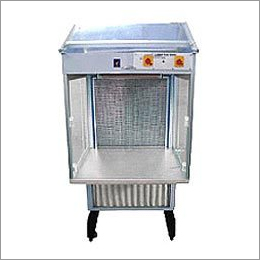
Laminar Air Flow Table provides air flow in the work area for operations where product is of utmost importance. Laminar flow principles include double filtration of air. Herein, atmospheric air is drawn by pre-filters through heavy duty blowers afterwards air is passed by extremely effective HEPA (High Efficiency Particular Air) filters which filter almost all air borne particles of size as small as 0.3 micron and larger. Double filtered laminar flow air blows through the work table, at a nominal controlled velocity of approx. 90 feet / min. It is supplied with stainless steel table top, transparent front door, flexi glass, built in U.V. light, static pressure inclined manometer, built in supply cocks for air, gas, or vacuum lines.
Available In Following Sizes : - Working area 2 x 2 x 2, size of HEPA filter 2 x 2 x 6.
- Working area 3 x 2 x 2, size of HEPA filter 3 x 2 x 6
- Working area 4 x 2 x 2, size of HEPA filter 4 x 2 x 6
- Working area 6 x 2 x 2, size of HEPA filter 6 x 2 x 6
Advanced Contamination ControlThanks to its horizontal laminar flow technology and superior HEPA filter, this unit guarantees consistent, particle-free airflow across the work area. With 99.97% filtration efficiency at 0.3 microns, it provides reliable protection for sensitive laboratory or pharmaceutical tasks, limiting contamination from external sources and within the workspace itself.
Customizable Workstation DesignThe workstation table is constructed from robust SS 304 stainless steel, offering not only long-term durability but also customizable dimensions to fit your specific operational needs. Heavy-duty, lockable caster wheels provide mobility and stability, while surface options such as powder-coated MS enhance practicality.
Enhanced User Safety and ConvenienceUser safety is prioritized with features such as UV light interlock and a safety alarm for filter replacement. The workstation includes a bright LED or fluorescent lighting setup, an analog or digital manometer for monitoring airflow, and easy-to-clean surfaces for efficient maintenance.
FAQs of Laminar Air Flow:
Q: How does the horizontal laminar air flow system help control contamination?
A: The horizontal laminar air flow system directs filtered air across the work table in a smooth, uniform motion, trapping airborne particles with a HEPA filter that achieves 99.97% efficiency at 0.3 microns. This mechanism minimizes the risk of sample or product contamination in laboratory, research, or pharmaceutical environments.
Q: What maintenance is required for the pre-filter and HEPA filter?
A: The washable synthetic pre-filter should be cleaned periodically, typically every few weeks depending on usage intensity, to maintain optimal airflow and extend the life of the HEPA filter. The HEPA filter should be checked regularly and replaced as indicated by the safety alarm or reduced air velocity readings to ensure consistent filtration performance.
Q: When should I change the HEPA filter, and how will I know its time?
A: The system is equipped with a safety alarm that alerts you when the HEPA filter requires replacement. Additionally, a manometer displays pressure differences that can signal filter clogging. Filters usually need changing annually or sooner in high-use environments.
Q: Where can this laminar air flow workstation be used?
A: This workstation is suitable for laboratories, pharmaceutical production, research centers, medical facilities, and other settings where clean, contamination-free environments for handling sensitive samples or products are essential.
Q: What benefits does the stainless steel (SS 304) work table provide?
A: The SS 304 stainless steel work table offers excellent resistance to corrosion, ease of cleaning, and enhanced hygiene. Its durability and smooth surface ensure long-term reliability and easy decontamination, meeting high laboratory and clinical standards.
Q: How does the UV light interlock improve safety during operation?
A: The UV light interlock feature prevents accidental exposure to UV rays by ensuring that the UV lamp cannot be turned on when the sliding front door is open. This safeguards users from UV-related health risks and enforces proper usage protocols.




 Send Inquiry
 Send Inquiry

