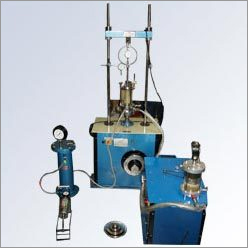
About Abrasion Testing Machine
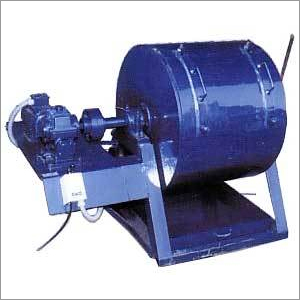
We manufacture and supply one of the major aggregate testing equipment, the Los Angeles
Abrasion Testing Machine. It has been designed as per IS: 10070. The Los Angeles Abrasion Testing Machine is used for the determination of the resistance to wear of crushed rocks and small size aggregates.
Machine Components : The machine comprises a hollow cylinder that is mounted on a robust frame on ball bearings. A detachable shelf that spreads throughout the inner length of the drum catches the abrasive charge without allowing it to fall on the cover. The drum is revolved at a speed of 30-33 RPM through an electric motor by a heavy duty reduction gear. Motor is apt for operation on 3 phase, 440 volts, and A.C. supply. The unit is offered with a tray for accumulation of the material with abrasive charge. It is also offered with 12 nos. hardened steel balls (Abrasive Charge) of 48mm dia.
Efficient Digital PerformanceThis abrasion testing machine integrates a digital counter and intuitive start/stop controls, streamlining the entire testing process. Users can preset cycles effortlessly, monitor progress in real time, and achieve consistent, repeatable results. Its semi-automatic operation enhances productivity, allowing for convenient testing with minimal manual intervention.
Sturdy and Reliable ConstructionCrafted from high-quality mild steel and featuring a powder-coated finish, the machine is built to withstand rigorous laboratory and industrial environments. Its robust build, along with a noise level below 70 dB, ensures smooth operation without distractions, making it ideal for continuous or frequent testing routines.
Versatile ApplicationsThe rotary abrasion tester is suitable for assessing abrasion resistance in a broad spectrum of materials such as fabrics, rubber, paint, floor tiles, and coatings. Its application across quality control, industrial manufacturing, and R&D labs supports comprehensive material analysis, crucial for product development and quality assurance.
FAQs of Abrasion Testing Machine:
Q: How is the digital abrasion testing machine operated?
A: The machine features a user-friendly control panel with a digital display, cycle preset options, and start/stop controls. After preparing the sample and mounting it with the appropriate accessories, set the desired number of test cycles, pressure (10-40 N), and initiate the test; the machine runs automatically until completion or until you stop it.
Q: What kinds of materials can be tested using this rotary abrasion tester?
A: This abrasion testing machine is designed for evaluating the abrasion resistance of a range of materials, including textiles, rubber, floor tiles, paints, and coated surfaces, making it suitable for diverse industries such as manufacturing, construction, and textiles.
Q: When should I use this abrasion testing machine in my quality control process?
A: Employ this machine during the quality assurance or R&D phases when you need to determine the durability and abrasion resistance of materials prior to product launch or during routine quality checks. It helps verify compliance with standards like ASTM D3884 or IS 12673.
Q: Where is this abrasion testing machine typically used?
A: It is commonly used in quality control laboratories, research and development centers, as well as in industrial manufacturing sectors across India and internationally. Its versatile design allows for bench-top placement that fits standard laboratory and industrial settings.
Q: What is the standard test cycle range and accuracy of this machine?
A: The machine allows users to preset test cycles up to 9999, providing flexibility for various testing needs. It delivers high precision with an accuracy of 1%, ensuring reliable and consistent measurements for all tests conducted.
Q: How does the abrasion testing process work on this machine?
A: The sample is fixed securely using sample holders, counterweights, and specimen clips. Abrasive wheels are engaged as the specimen rotates at 72 rpm, gradually wearing the samples surface. The digital counter tracks the number of cycles until the preset or endpoint is reached, providing objective abrasion resistance data.
Q: What are the main benefits of using this abrasion tester for my business?
A: Key benefits include increased testing efficiency, high accuracy, minimal operator effort due to semi-automatic function, and reliable compliance with industry standards. Its sturdy construction, low operating noise, and simple digital controls make it a valuable addition to any quality control or R&D laboratory.




 Send Inquiry
 Send Inquiry

